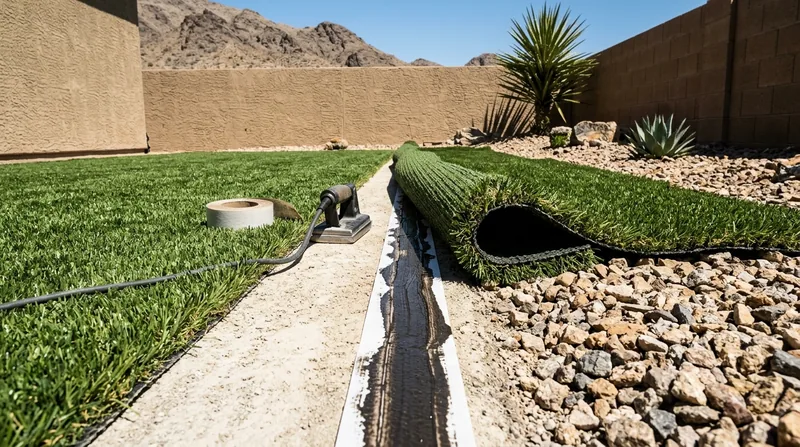




Henderson's turf takes a beating. Spring winds lift edges along MacDonald Highlands estates and Seven Hills hillside yards. Summer heat at 115°F splits seams in residential turf installed in the 1980s-90s master-plan neighborhoods of Green Valley and West Henderson. Window reflections from stucco block walls and wrought-iron view fences melt lines into pool surrounds and patio turf near the Lake Las Vegas resort communities. Sunken spots appear over soft or inadequate base prep in yards where caliche and rocky hillside soil were not properly graded. Turf repair and seam repair in Henderson restores a yard that has taken damage, cuts out the problem section, sets in matching material, re-levels the base and tops up infill so the patch blends and performs like the original installation. We photograph every repair before and after, and the work carries a one-year workmanship warranty. A single seam split or lifted edge can start small and spread; catching damage early keeps repair costs down and turf life up.
Why Turf Repair and Seam Repair Matter in Henderson's Desert Climate
Henderson turf fails in predictable ways because the climate and terrain are predictable. The valley floor stays flat and hot; hillside yards in Anthem and Seven Hills face direct sun exposure and afternoon wind tunnels. Seams separate when turf expands and contracts in 50-degree temperature swings between day and night, especially in spring and fall. Edges lift when wind-driven stress concentrates at perimeter seams, or when base prep was shallow and infill settled unevenly. Melt lines appear where south-facing windows or reflective surfaces concentrate solar heat beyond what the turf material can tolerate. Sunken spots mark old irrigation leaks, poor drainage under the turf, or base that was not compacted to 95 percent density before installation. Ignoring these failures leads to larger repairs, exposed seams that trap debris and pet odor, and sections that separate entirely.
- Seam splitting happens when thermal stress exceeds the adhesive bond, most common in south-facing yards and near reflective surfaces.
- Edge lifting is driven by wind load and inadequate base support, especially on hillside lots in Anthem and along the McCullough Range.
- Melt lines form where concentrated solar reflection from windows or light-colored walls heats turf surface to 150°F or higher.
- Sunken patches indicate soft or settled base, poor drainage, or infill loss from foot traffic and pet activity.
- Early repair prevents secondary damage: separated seams trap dirt, pet urine pools in low spots, and moisture wicks into the base.
Addressing turf damage promptly keeps the yard safe, clean and performing as designed.
Key info: Henderson's spring wind season (March through May) drives most edge-lifting complaints. Summer heat (June through September) is when seams split and window-reflection melt lines appear most visible. Fall and winter are the best windows for repair work, when thermal stress is lowest and the patch has time to settle before heat season returns.
For technical guidance on turf base standards and infill specifications, see the residential artificial grass installation page.
How We Repair Turf and Seams in Henderson: Step by Step
Turf repair is not sewing or patching with glue and hope. We cut out the damaged section in a clean rectangle or diamond, remove the old infill from the repair zone, inspect and re-level the base (adding new base material and compacting to 95 percent density if needed), source a matching turf product with the same face weight, pile height and color, heat-weld or seam-tape the patch edges depending on the turf type, add new infill to match the surrounding yard, and finish by brushing and leveling. The entire repair is documented with before and after photos. A typical seam repair takes one to three hours; larger patches or multiple repairs on the same yard may take a full day. We work around existing landscaping, hardscape and irrigation without disturbing them.
- We inspect the damage site, measure the affected area, and assess the base condition underneath.
- We cut out the damaged turf section in a clean geometric shape (rectangle or diamond) to expose the base.
- We remove old infill from the repair zone and inspect the base for settling, moisture or compaction issues.
- We re-level and re-compact the base to 95 percent density, adding new base material if the original is inadequate.
- We source matching turf product (same brand, face weight, pile height and color) and cut a patch to fit the repair opening.
- We heat-weld or seam-tape the patch edges, depending on turf type and seam location.
- We add new infill to match the surrounding yard and brush the patch to blend texture and appearance.
- We photograph the completed repair and provide a one-year workmanship warranty.
This methodical approach ensures the repair integrates with the existing turf and does not fail again in the same spot.
Example: A homeowner in Green Valley noticed a two-foot seam split running along the south edge of their backyard turf, caused by summer heat and inadequate base prep at installation. We cut out a four-by-six-foot section, re-compacted the base, installed matching turf with proper infill depth, and sealed the new seams. The repair cost $650 and took 2.5 hours. Six months later, the patch is invisible and performing identically to the surrounding yard. This is why catching seam damage early matters: a one-foot split costs less to fix than a six-foot separation.
For more detail on turf specifications and base requirements, see our pricing and specifications overview.
Turf Repair Methods: Seams, Edges, Melt Lines and Sunken Spots
| Repair Type | Description | Best for |
|---|---|---|
| Seam Repair | Cut out the separated seam section, re-compact base, install matching turf patch with heat-welded or taped seams, add fresh infill and blend. | Split seams from thermal stress, sun exposure, or adhesive failure. Typical size 2 to 8 feet long by 1 to 2 feet wide. |
| Edge Lifting Repair | Cut back the lifted edge, inspect and re-compact the base, re-secure the turf edge with heat-weld or seam tape, top up infill and feather the transition. | Perimeter edges lifted by wind, inadequate base support, or settling. Common on hillside yards and wind-exposed sides. |
| Melt Line Repair | Remove the melted section (usually a linear burn mark), cut out damaged turf, re-grade base, install matching patch with proper infill, and assess window or reflective surface positioning. | Surface damage from concentrated solar reflection. Melt lines typically 1 to 3 feet long and follow a straight path from the reflective source. |
| Sunken Spot Repair | Remove turf from the sunken area, inspect for drainage problems or base settling, add new base material and compact to 95 percent density, reinstall turf patch and infill to level with surrounding yard. | Low spots caused by inadequate base prep, old irrigation leaks, or infill loss. Must address drainage before repair or the spot will sink again. |
| Multi-Patch Repair | Multiple damage sites in the same yard repaired in one visit: seams, edges, melt lines and sunken spots are all addressed, with consistent infill and base standards applied across all patches. | Yards with several problem areas from neglect, poor original installation, or accumulated weather damage. More cost-effective than multiple single repairs. |
Each repair method is tailored to the failure mode. Seam splits need heat-weld integrity. Edge lifts need solid base re-compaction. Melt lines need removal of compromised material. Sunken spots need drainage assessment. Matching the repair to the damage type ensures the fix lasts.
Turf Repair and Seam Repair Cost in Henderson: What to Expect
Turf repair pricing depends on the size of the damaged area, the depth and condition of the base underneath, whether the turf product is still available from the original manufacturer, and the location of the repair (accessible backyard versus tight side yard or hillside). A small seam split (2 to 4 feet long) typically costs between $350 and $550. A larger patch (6 to 12 feet long or 4 by 8 feet in area) runs $650 to $1,200. Multiple repairs on the same yard are more efficient and cost less per patch than single isolated repairs. Edge lifting repairs range from $400 to $800 depending on how much edge needs re-securing and base work. Sunken spot repairs that require drainage investigation and base reconstruction can run $500 to $1,000 or more if the underlying problem is significant. Travel is included in Henderson and surrounding areas with no separate mileage fee. We provide a free estimate within 24 hours and never charge for the site visit or measurement.
The biggest cost variable is base condition. If the base is solid and only the turf and infill are damaged, repair is straightforward and fast. If the base is soft, settled or wet, we must remove more material, add new base, re-compact and then install the patch. That adds time and materials. We always photograph the base condition during the repair so you can see what was underneath. Matching the turf product is also critical: if the original turf is out of production, we source the closest equivalent and note the slight color or pile difference on the estimate. For complex repairs or multiple problem areas, we recommend a site visit before quoting, because the base condition cannot be assessed from photos.
For a detailed pricing breakdown across all services, visit our full pricing page.
What to Look for When Hiring a Turf Repair Company Near Henderson
Hiring the right turf installation company for repair work is as important as the original installation. Many contractors lay turf once and disappear; a good repair company understands that damaged turf reveals what went wrong the first time, and fixes it properly so it does not fail again. When vetting any turf installer near Henderson, ask for proof of full insurance covering general liability and workers compensation, request a written specification of the turf product (brand, face weight, pile height, infill type and pounds per square foot, and base depth and compaction standard), check references and ask to see photos of completed repairs on similar damage. Verify that the company has a local Henderson address and phone number, not a call center or franchise operation. Ask whether they handle their own work or subcontract to crews, because consistency and accountability matter in repair. A reputable turf company will walk you through the damage, explain why it happened, show you what the base looks like, and tell you honestly if the repair is worth doing or if a larger section needs replacement.
- Request a certificate of insurance naming general liability and workers compensation coverage before work begins.
- Ask for a written estimate that specifies the turf product name, face weight, pile height, infill type and pounds per square foot, and base depth.
- Check at least two references and ask specifically about repair quality and how the patch has held up over time.
- Verify that the company has a local Henderson address and direct phone number, and confirm they perform the work themselves.
- Ask to see before and after photos of similar repairs (seams, edges, melt lines, sunken spots) so you can assess their quality standard.
- Confirm the warranty on the repair work in writing, and understand what it covers (seam separation, infill loss, base settling, etc.).
- Discuss whether the original base and installation were adequate, and whether the repair addresses the root cause or just patches the symptom.
A company that answers these questions thoroughly and provides documentation is one you can trust to repair turf correctly.
Ready to get your turf repaired? Contact us for a free estimate at (725) 999-9611, or visit our service areas page to confirm we cover your neighborhood in Henderson, Green Valley, Anthem or East Henderson.
Turf Repair & Seam Repair in Henderson: Pricing Guide
| Service | Price | Details |
|---|---|---|
| Small seam or edge repair | Starting at $350 | 2 to 4 feet of seam split or edge lift, solid base, matching turf available, one to two hours labor |
| Medium patch repair | Starting at $650 | 4 to 12 feet of seam or 4 by 8 foot patch area, base inspection and re-compaction included, two to three hours |
| Large or complex repair | Starting at $900 | Multiple damage sites, base reconstruction needed, drainage issues, or sunken spot requiring investigation and fix |
| Multi-patch repair (same yard) | On estimate | Two or more repairs in one visit cost less per patch than single isolated jobs; site visit required to assess all damage |
| Travel | Included | No separate mileage fee in Henderson, Green Valley, Anthem, West Henderson, East Henderson, or Lake Las Vegas |
| Free estimate | No charge | Response within 24 hours, site visit included, no obligation to book, photos and written spec provided |
Indicative pricing, the exact cost depends on square footage, finish, and site access. Free personalized estimate within 24h at (725) 999-9611.


